
What Does the Evil Eye Mean? History, Symbolism, and Why It's Blue
, by Divya Chatani de Tourani, 4 min reading time
, by Divya Chatani de Tourani, 4 min reading time
The evil eye (nazar) is a protective symbol found across Turkish, Greek, and Middle Eastern cultures, believed to ward off harm caused by an envious glance. Here's its real history, meaning, and how it's used today.
The evil eye — also called nazar, mati, or malocchio depending on where you are — is one of the oldest protective symbols still in everyday use. You'll see it on jewelry, hung by front doors, painted onto ceramics, and stitched into beach bags from Istanbul to Hong Kong. But what does it actually mean, where does it come from, and why is it almost always blue?
The evil eye refers to a belief found across many cultures: that a look given out of envy, jealousy, or even excessive admiration can bring misfortune, illness, or bad luck to the person or object it's directed at — often without the person giving the look intending any harm at all. The eye-shaped charm itself isn't the curse; it's the protection against it. The charm is believed to "watch back," symbolically absorbing or deflecting that negative energy before it reaches you.
The belief is genuinely ancient. The earliest known evil eye amulets have been traced back to around 3,300 BCE, excavated at Tell Brak in what is now modern-day Syria — one of the oldest known cities in Mesopotamia. Written references to the evil eye also appear in ancient Greek and Roman texts, with some of the earliest surviving mentions dating to around the 6th century BCE in Greece. According to Encyclopaedia Britannica, belief in the evil eye is considered ancient and ubiquitous, appearing across Greek, Roman, Jewish, Islamic, Buddhist, and Hindu traditions.
From there, the belief spread and took root across an enormous range of cultures — Mesopotamian, Greek, Roman, Jewish, Islamic, Hindu, and Buddhist traditions all developed their own versions of it, each with a different name but a strikingly similar core idea.
Because the belief spans so many regions, the evil eye goes by different names depending on where you are:
Despite the different names and independent cultural histories, the core belief stays remarkably consistent: an unintentional, envious glance can cause real harm, and a visual charm can protect against it.
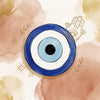
The classic blue-and-white eye design is most strongly associated with Turkey and Greece, where it's traditionally made from glass, historically colored with cobalt oxide to achieve that deep blue. Blue has long been linked to protection and calm in the regions where the belief is strongest, and glass itself was historically a valued, somewhat rare material — which likely reinforced the charm's protective status.
While blue and white is the traditional combination, the evil eye motif today appears in many colors and materials — hand-painted onto ceramics, hand-beaded onto textiles, or worked into metal — without changing its core meaning.

The evil eye is often seen alongside the Hamsa, a hand-shaped protective symbol, and the two are sometimes combined — an eye set into the palm of a hand. "Hamsa" comes from the Arabic word for "five," referring to the five fingers. In some Islamic traditions it's also called Fatma's Hand, referencing the Prophet Muhammad's daughter. Like the evil eye, the Hamsa is used as protection against harm and misfortune, though it developed as a distinct symbol with its own history rather than a variant of the nazar.

The nazar has moved well beyond its original homelands. It's now a genuinely global symbol — worn as jewelry, hung in homes and cars, given as a gift for new babies or new homes, and incorporated into everyday objects from teacups to beach bags. For some, it remains a serious protective object tied to real belief. For others, it's become a recognizable design motif carrying a simple, positive message: protection, and good wishes for whoever receives it.
That dual nature — meaningful heritage symbol and genuinely beautiful design — is part of why it's remained so consistently popular as a gift across generations and cultures.

We work with artisans in Turkey and Jordan who hand-paint, hand-bead, and hand-embroider the evil eye motif onto everything from teacups to jewelry to home decor. A few places to start:

Or browse the full Evil Eye Protection collection for the complete range — home decor, jewelry, and accessories, all hand-made by artisans who've been working with this motif for generations.
For a full breakdown of every evil eye piece we carry across categories, see our complete Evil Eye Guide.