
The Real Story Behind Moroccan Ceramics: Fez, Safi, and What Makes Them Handmade
, by Divya Chatani de Tourani, 4 min reading time
, by Divya Chatani de Tourani, 4 min reading time
Moroccan ceramics vary dramatically by region — Fez's cobalt blue, Safi's vivid multicolor, Tamegroute's earthy green. Here's the real history and craft behind hand-painted Moroccan pottery, and how to tell the genuine, handmade kind apart.
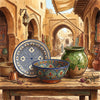
Moroccan ceramics — the hand-painted plates, bowls, and tagines you'll see in riads and markets across Morocco — are one of the country's oldest and most recognizable crafts. But behind the geometric blue-and-white patterns and vivid multicolor designs lies a tradition that varies significantly depending on which city it came from. Here's what actually distinguishes real Moroccan pottery, region by region.
Pottery in Morocco dates back more than 6,000 years, starting with the Berber (Amazigh) people, who shaped clay by hand into jars, tagines, and everyday vessels. Around 1000 BCE to 300 CE, Phoenician and Roman influence introduced the pottery wheel and more advanced throwing techniques to the region.
The craft as it's recognized today is really a fusion of two traditions: rural Berber pottery — often hand-molded, historically made by women, decorated with geometric symbolism — and the urban, glazed, kiln-fired pottery introduced by Arab-Andalusian artisans who arrived in Morocco from Spain centuries later. That blend of influences is why Moroccan ceramics look the way they do: geometric at their core, but layered with the arabesque and floral detail brought over from Andalusia.
Fez (Fès), Morocco's oldest imperial city, has been a center of ceramic production for over 600 years. Its pottery is defined by one thing above all: a deep cobalt blue, often called "Fez blue" or "Bleu de Fès," hand-painted onto a pale background in intricate geometric and floral patterns. According to Encyclopaedia Britannica, Fez's old city was named a UNESCO World Heritage site in 1981, and pottery-making is still practiced in the narrow, winding streets of its historic medina.
That signature look comes directly from the local geography. The clay found around Fez is naturally fine-grained and grey, and lightens significantly as it dries and fires — which is exactly what makes it such a good canvas for the cobalt decoration painted on top. Fassi potters traditionally use foot-turned wheels and a double-firing process, and the resulting pieces are dense and durable enough that many hold up fine in a microwave or dishwasher, despite being centuries-old techniques.

Safi, a coastal town, has grown into the largest ceramic production hub in Morocco, with an estimated 2,000-plus working artisans. Production there dates back to around the 15th century, built on the region's local red clay.
Where Fez is defined by restraint — blue on white, geometric and precise — Safi is defined by color. Safi potters work with a much wider palette: greens, yellows, oranges, and blues layered into elaborate floral and geometric patterns. A potter named Boujemaa Lamali is widely credited with founding Safi's first formal ceramics school in the early 20th century, introducing metallic highlights and more abstract geometric design, and helping establish Safi as the country's dominant ceramic export center.
Further south, the small village of Tamegroute is known for something entirely different — a distinctive, rustic green glaze, achieved using natural minerals (manganese and copper) rather than imported pigment. It's a much simpler, earthier style than Fez or Safi, but just as regionally specific and just as handmade.
In all three traditions, the process hasn't changed much: clay is shaped (by wheel or by hand), dried, often fired once, hand-painted by an individual artisan, glazed, and fired again. Because a person — not a machine — paints every piece freehand, no two are ever identical. Slight variations in line weight, pattern spacing, or glaze pooling aren't flaws; they're the actual signature of the technique. If two "Moroccan ceramic" pieces from the same collection are perfectly, machine-identically uniform, that's usually a sign they weren't hand-painted by an artisan at all. See our full Artisan Craft Techniques Guide for how this compares to our other hand-made lines — metalware, beading, wood-carving, and glass.
Our Moroccan ceramic collections are hand-painted by artisans in Morocco, continuing this same tradition of individually-painted, geometric design. Our Akleja and Tiri lines sit within the classic blue-and-white tradition — the same cobalt-on-pale-clay palette that's defined Moroccan ceramics for centuries. Our Azala line takes the same geometric hand-painting technique in a bolder black-and-white palette.

A few pieces to start with:

Browse the full Tableware collection for the complete range of hand-painted ceramics.