
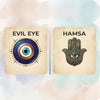
What's the Difference Between a Nazar and a Hamsa?
, by Divya Chatani de Tourani, 2 min reading time
, by Divya Chatani de Tourani, 2 min reading time
Nazar and Hamsa are often confused, but they're two separate protective symbols with different origins — here's the real difference and why they're so often seen together.
Nazar and Hamsa are the two most common protective symbols you'll see in Middle Eastern and Mediterranean-inspired home decor and jewelry — and they're often confused for each other, or assumed to be the same thing. They're not. Here's the real difference.
The nazar, commonly called the "evil eye," is an eye-shaped charm, traditionally blue and white. It's rooted in a belief found across dozens of cultures: that an envious or admiring glance — even one given without any bad intention — can cause misfortune to whatever it's directed at. The charm is believed to symbolically "watch back," deflecting that negative energy. Encyclopaedia Britannica notes that belief in the evil eye is ancient and found across Greek, Roman, Jewish, Islamic, Buddhist, and Hindu traditions, among others. The earliest known nazar amulets date back to around 3,300 BCE.
The Hamsa is a hand-shaped symbol, usually shown palm-forward with the fingers spread or together. "Hamsa" comes from the Arabic word for "five," referring to the five fingers. In some Islamic traditions, it's also called the Hand of Fatima. Like the nazar, it's used for protection — but it developed as its own distinct symbol, with its own separate history, rather than as a variation of the evil eye.
The two symbols are frequently combined — an eye set into the palm of a hand — which is likely why they get confused. Both are protective symbols from overlapping regions (Middle East, North Africa, Mediterranean), both are commonly rendered in blue, and both show up on the same categories of objects: jewelry, wall hangings, tableware, keychains. But they are two separate symbols with two separate origins, not one thing with two names.
Read more about the evil eye's full history in our evil eye meaning guide, browse our complete Evil Eye Guide for the full range by category, or explore the Evil Eye Protection collection for pieces featuring both symbols, hand-painted and hand-embroidered by artisans in Turkey and Jordan.